Progressive Cavity Pump
What is a mono pump?
Mono pumps are positive displacement pumps widely used in industrial processes where viscous, abrasive, sticky, aggressive, or solids-containing fluids must be transferred with a linear (steady) flow. Due to their operating principle, they are also known as eccentric screw or helical pumps.
Operating principle
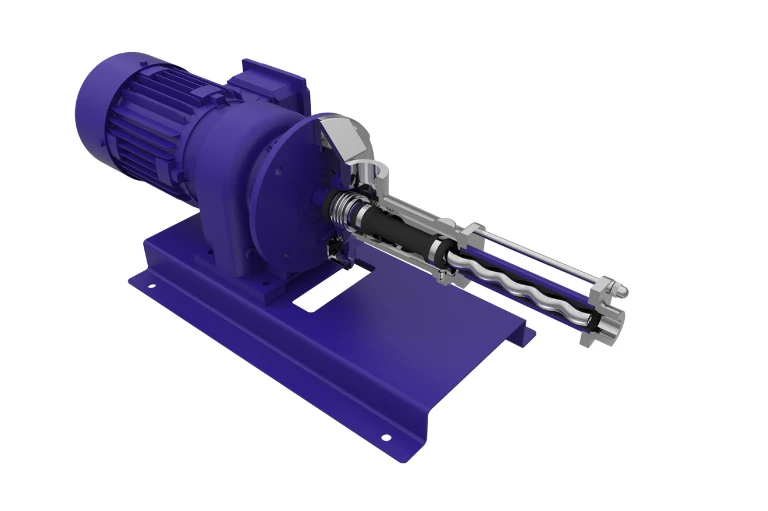
A mono pump operates by transmitting power from an electric or hydraulic motor to the rotor via a shaft. The rotor rotates inside an elastomer stator. The rotor–stator geometry and tolerance enable the fluid to move from the suction chamber to the discharge.
Key advantages
Suitable for viscous and abrasive fluids thanks to low-speed operation; the stator’s flexible structure helps minimize wear. Linear, low-vibration flow is advantageous especially in processes requiring flow measurement; pulsation in alternative pump types can disrupt measurement and damage piping components.
Viscous and abrasive fluids
In addition to the operating principle described above, mono pumps are well-suited for transferring viscous and abrasive fluids because they operate at low speeds. The stator’s flexible structure minimizes the damage that abrasive media can cause to pump surfaces. The rotor–stator tolerance also helps reduce the risk of clogging.
Linear, low-vibration flow
Mono pumps provide linear flow with low vibration at the discharge line, which is a major advantage especially in processes requiring flow measurement. In comparable pump types, pulsation can disrupt flow measurement and may also damage pipelines and associated components.
Thixotropic and rheopectic fluid applications
Compared to many alternative pumps, mono pumps apply significantly lower shear forces to the transferred fluid. Therefore, mono pumps are a suitable option for the transfer and dosing of thixotropic fluids whose viscosity decreases after a certain shear level (e.g., olive oil, adhesives, etc.), rheopectic fluids whose viscosity increases under shear (e.g., cream), and other shear-sensitive fluids.
High pressure and high flow
In processes that require high pressure or involve long transfer lines, mono pumps offer multiple model options, with capacities up to 300 m³/h and pressure ratings up to 48 bar.
Operation under vacuum
Mono pumps are capable of suction under low pressure. Within certain limits, they can draw fluid into the suction chamber under vacuum.
Low capital cost
Mono pumps generally have a lower capital (initial investment) cost compared to equivalent positive displacement pump alternatives.